
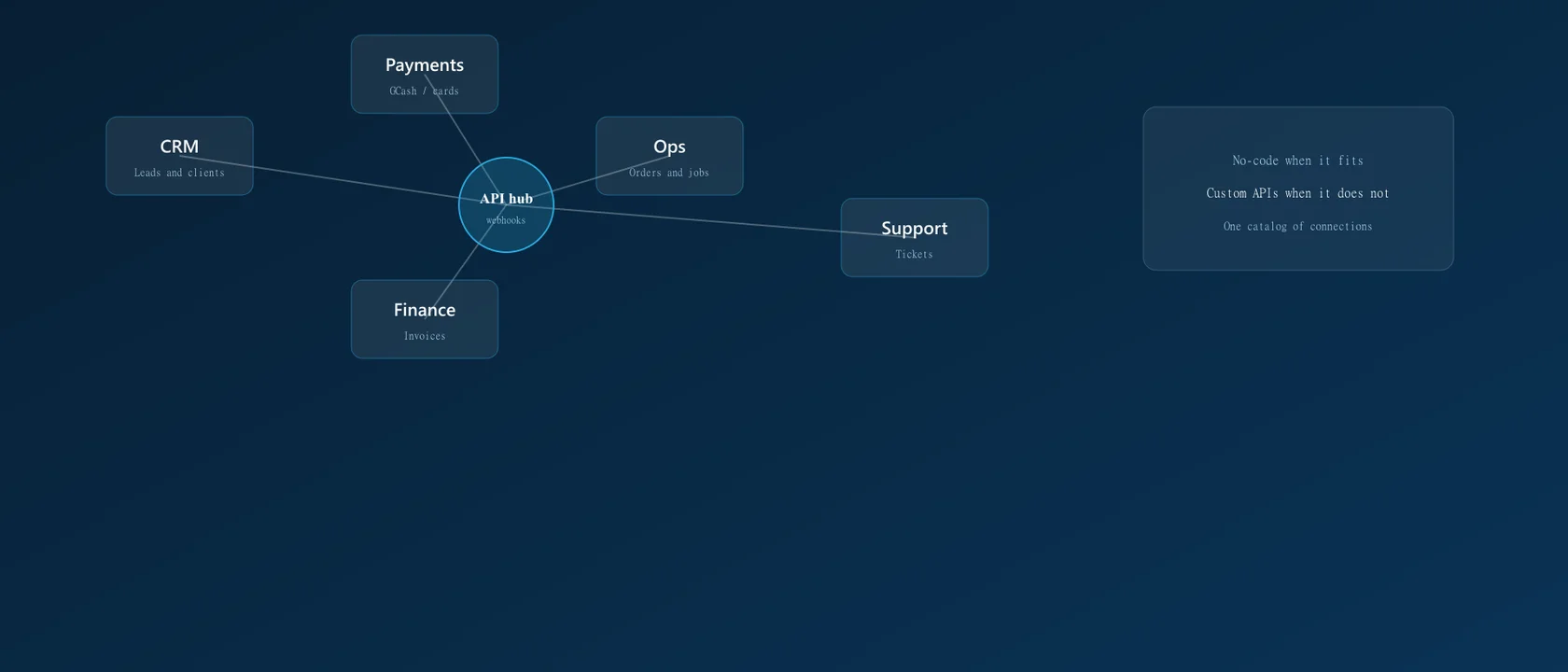
Philippine SMEs rarely wake up wanting a “integration strategy.” They wake up with orders in one app, inventory in another, and finance reconciling exports every week. In 2026 the trend is not ripping everything out for one mega-platform — it is composable integration: connecting the tools you already pay for with APIs, webhooks, and a thin layer of custom logic when no-code is not enough.
Here is a practical read for owners and ops leads who are tired of copy-paste between systems.
What “composable” actually means
Composable does not mean microservices buzzwords. It means your stack behaves like Lego blocks:
- Each tool owns its job (CRM, accounting, warehouse, storefront).
- Data moves between them through documented APIs or event hooks (order placed, payment confirmed, stock adjusted).
- When a vendor changes pricing or adds a feature, you swap or extend one block instead of replatforming the business.
For Philippine teams, that matters because budgets are tight and timelines are short. A full ERP replacement is a year-long bet. Wiring Shopee orders into your inventory sheet through a reliable pipeline can be weeks — if the foundation is sane.
The three integration lanes in 2026
Most businesses land in one of these lanes (often a mix):
1. No-code connectors (Zapier, Make, native “automations”)
Good for: low-volume, simple triggers — new form submission → Slack message, paid invoice → spreadsheet row.
Weak when: volume spikes, you need idempotency (the same event must not create duplicate shipments), or error handling has to be auditable for finance.
2. iPaaS and middleware
Good for: mapping fields between SaaS products without writing a full backend team.
Weak when: Philippine-specific flows (split payments, marketplace fees, BIR-related fields) need custom validation that generic mappers cannot express cleanly.
3. Custom API layer (often Laravel or similar)
Good for: your business rules — partial fulfillments, branch-level stock, approval chains, retry logic when a gateway times out.
Weak when: you build it before you understand the workflow. Custom code amplifies bad process design.
The trend we see: start in lane 1 or 2, graduate to lane 3 only where money, inventory, or compliance is on the line.
Signs you have outgrown Zapier-only
- Staff still manually fix failed sync rows every morning.
- Nobody can answer “what is the source of truth for stock or revenue this month?”
- Integrations are person-dependent — only one admin knows the Make scenario.
- Peak sale days (payday weekends, 11.11) produce duplicate orders or missing payments.
Those symptoms overlap with what we described in The Hidden Cost of Manual Business Processes. Integration is often how you make manual work visible — then automate the boring parts.
API-first without replatforming
You do not need to replace your storefront to get composable benefits. Typical sequence for Philippine retail and services:
- Inventory one source of truth — even if it is a simple database or ops module, not seventeen sheets.
- Webhook or API ingestion from channels you sell on (site, marketplace, social checkout).
- Outbound sync to accounting with immutable logs — who changed what, when.
- Human approval only where judgment is required (refunds, exceptions).
That is the same architectural instinct as How We Build Scalable Web Applications: a clear core, other systems as clients.
When to involve a development partner
Bring in custom integration work when:
- Failed syncs have financial or legal consequences.
- You need role-based access and audit trails, not shared admin passwords on five SaaS accounts.
- You are planning agentic or AI-assisted ops later — agents need structured APIs, not screenshots of Viber threads.
If the problem is still messy spreadsheets, fix the process first. We are blunt about that in When to Build Custom Software Instead of Another Website.
Budget and timeline (honest ranges)
Small connector projects (one channel → one internal record) often land in short sprints if requirements are frozen. Multi-channel inventory with reconciliation usually spans phased delivery — one channel live, then the next — because edge cases only appear under real load.
Quotes that assume “set and forget” integrations are red flags. Connectors break when vendors change APIs, SKUs multiply, or someone adds a discount rule at midnight before a sale.
Straight next step
Mapping composable integrations for 2026 does not start with a tool list. Start with one flow that hurts every week — orders, payouts, or stock — and name the systems involved.
Describe that flow on our contact page. We will tell you whether no-code, middleware, or a small custom layer fits — and point you to our business process automation & integrations service when a build is the honest answer.