
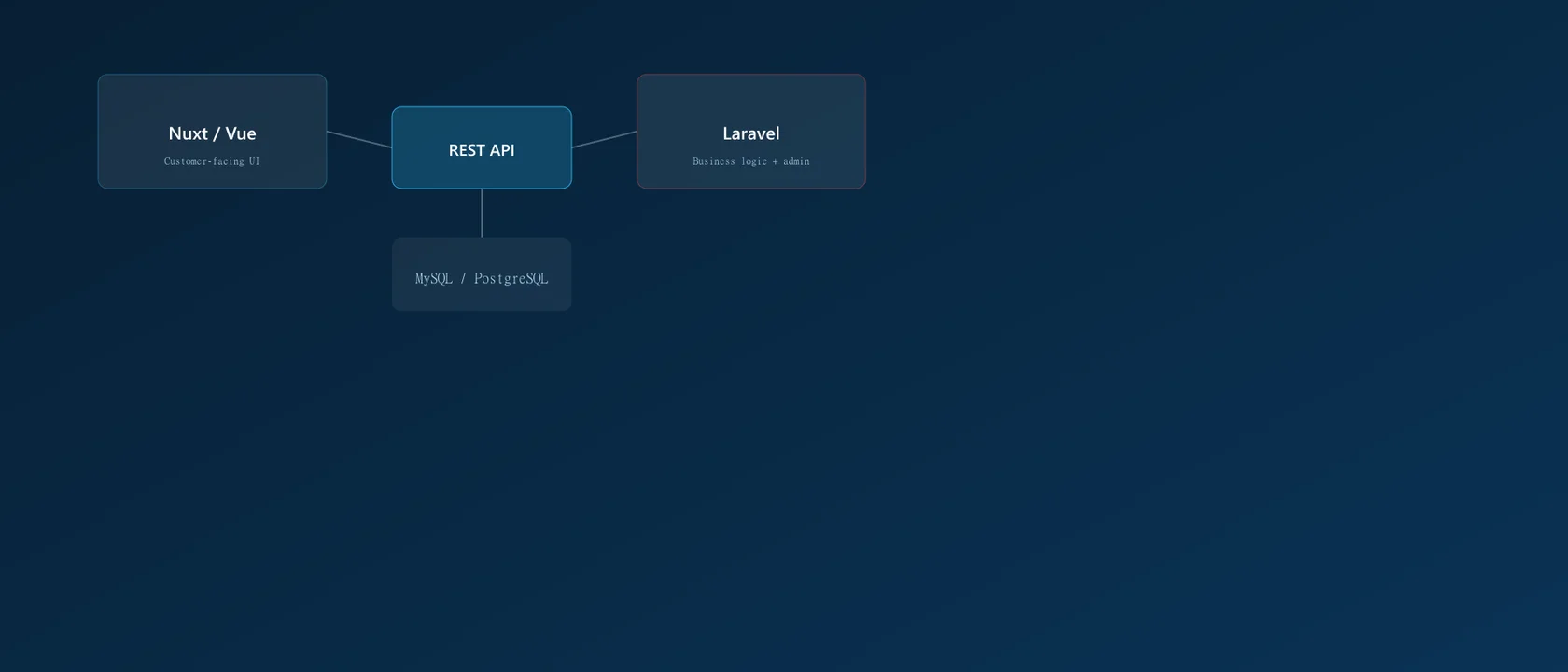
"Scalable" gets thrown around in proposals without meaning much. Here is how we actually build scalable web applications at PrimeCode — Laravel, Nuxt, API-first — explained for business owners who need systems that grow without breaking every six months.
This is not framework marketing. It is how we keep public experiences fast and operational backends maintainable.
What "scalable" means in plain terms
A scalable web application handles growth along at least three axes:
- User volume — more customers, staff, branches, transactions
- Feature depth — new modules attach without rewriting the core
- Team velocity — future developers understand the system without archaeology
Scalable does not mean "build everything day one." It means today's decisions do not trap you in rebuilds when tomorrow's rules arrive.
API-first — one brain, multiple faces
We separate business logic from interfaces:
- Laravel API — permissions, workflows, data integrity, integrations, background jobs
- Nuxt front end — fast public marketing and customer portals
- Admin tools — Filament, Inertia, or focused internal UIs as the job requires
Why business owners should care:
- Your customer site can evolve visually without corrupting operational data rules
- Mobile apps or partner integrations can share the same API later
- Admin changes do not require redeploying the entire marketing site for every fix
API-first is how you avoid "two systems that disagree" — the UI says booked, the database says available.
Laravel for the operational core
Laravel is our default for business logic because it fits long-lived products:
- Clear structure for permissions and auditing
- Mature ecosystem for queues, notifications, and integrations
- Testable domain rules — cancellations, proration, approvals — encoded once
We model domains before controllers (see domain modeling discipline) so Laravel reflects how your team works — not generic CRUD with your logo.
Nuxt for public and customer experiences
Nuxt gives us:
- Server-rendered pages for SEO and fast first paint
- Disciplined JavaScript on marketing routes
- Component reuse without page-builder bloat
Public performance matters for revenue — see Why Website Speed Affects Revenue. Nuxt helps us hit strong real-world scores without gimmicks.
Performance is scoped separately
Marketing site speed targets differ from admin panel complexity. We do not pretend one Lighthouse score describes your entire product. We scope:
- Public routes — lean, fast, crawlable
- Authenticated apps — optimize for task completion and reliability
Both should be intentional — not accidental.
Modular growth — phase two without demolition
Good architecture lets you ship v1 focused and expand:
- Add a reporting module without rewriting bookings
- Open a second branch with shared permissions model
- Integrate accounting exports when finance is ready
We say no to cloning spreadsheets tab-for-tab into screens. We yes to replacing the costliest bottleneck first — then growing with clear boundaries.
Production example
Courtside Alley pairs a Nuxt customer experience with a Laravel booking core — live availability, open play, club registration. Venue-specific rules live in the domain layer, not scattered across templates.
That is the pattern: one coherent system, not a website plus a pile of plugins.
What we avoid
- Page builders as "the backend"
- Controllers that encode business rules differently than the admin UI
- Front-end frameworks loading heavy JS on every marketing page
- Integrations held together by daily manual CSV exports
Is this stack always the answer?
No. Small marketing sites may not need Laravel at all. Some teams fit existing SaaS honestly. We recommend this shape when custom operational software is justified — especially when mobile customers and internal staff share one source of truth.
Talk architecture without the jargon wall
Evaluating a scalable web application build in the Philippines? Contact us with your growth plan — new branches, product lines, or user types — and one workflow that breaks today. We will map whether API-first custom work is the right investment.