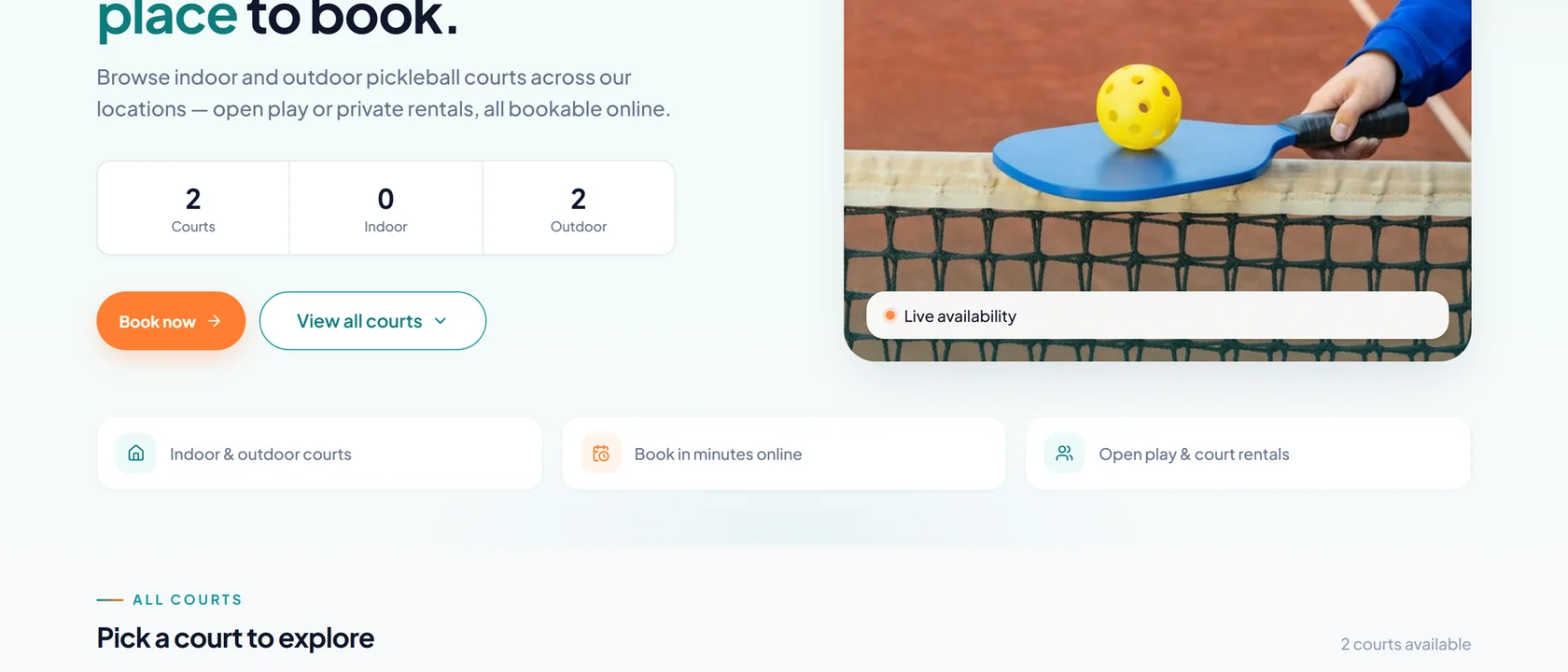
People search Courtside Alley because they want to play — or they want to know how a Philippine venue actually takes bookings online. This is the second kind of article: production lessons from a live pickleball booking platform, not the origin story.
The origin story is already written: from spreadsheets to production. The product is live at courtsidealley.com. Here is what we would repeat — and what we would not skip — on the next venue build.
Lesson 1: Availability is the product
Players do not care about your CMS. They care whether the slot they see is still free when they tap pay.
That forced us to treat the schedule as a domain, not a calendar plugin:
- Court rental vs open play are different products on the same clock
- Club-reserved time must disappear from guest booking without mysterious 404s
- Mobile is the default client — desktop-only admin thinking leaks into the player flow and they leave
If your venue still confirms in Viber after the website says “available,” you do not have online booking. You have a brochure with extra steps. Same pattern as booking ops on mobile and web.
Lesson 2: Model the venue, not “a generic booking SaaS”
Generic booking UX assumes one resource, one timezone, one price, one “appointment.” Pickleball (and a lot of PH venues) does not:
| Concept | Why a template fights it |
|---|---|
| Open play | Pay per player, drop-in, level mixing |
| Court rental | Hourly, group-owned, you control games |
| Club portal | Roster and locked slots, not consumer accounts |
| Location growth | Second site should not fork the schema |
We spent the time on states and permissions before pretty cards. That is the same habit as modeling the domain before controllers. Copying a foreign gym app and slapping a peso sign on it is how you get double-books.
Lesson 3: Two surfaces, one brain
Nuxt for players: browse courts, see what is on, book in a few taps. Laravel for the platform: courts, sessions, clubs, payments, staff tools.
Players get a fast public site. Operators get software that matches how a club actually runs. When those two disagree, trust dies in a group chat. API-first is not architecture theater here — it is how you avoid two sources of truth. See how we build.
Lesson 4: Launch is an operations event
Going live meant:
- Staff using the admin on a real Saturday, not a staging script
- A path for closures and “what’s happening at the courts” so players are not surprised at the gate
- Staying after cutover — venue software fails in the first month of edge cases (rain, no-shows, walk-ins)
A demo that books one happy path on Wi-Fi is not production. Production is the awkward Saturday.
Lesson 5: Do not turn the case study into the only product
Courtside Alley is a specific club and a specific platform. The reusable part is the pattern: live inventory, clear products, operator tools, mobile-first players.
If you run a clinic, court, or studio, your rules will differ. The questions stay:
- What is the unit of inventory?
- Who may override a booking?
- What happens to money when plans change?
- Can a staff member trust the screen without opening a spreadsheet?
What we would not do again
- Starting from a page builder and “adding booking later”
- Treating open play as a blog post with a GCash number
- Shipping player UI before club and staff workflows exist
- Assuming one location’s rules will survive a second site without a model
Straight next step
If you want the story of how it started, read the Courtside Alley case study and the work page. If you want to know whether your venue needs the same shape of system, tell us how you book today — spreadsheet, Facebook, or a tool that almost works. We will be direct about custom software versus tightening what you already have.